



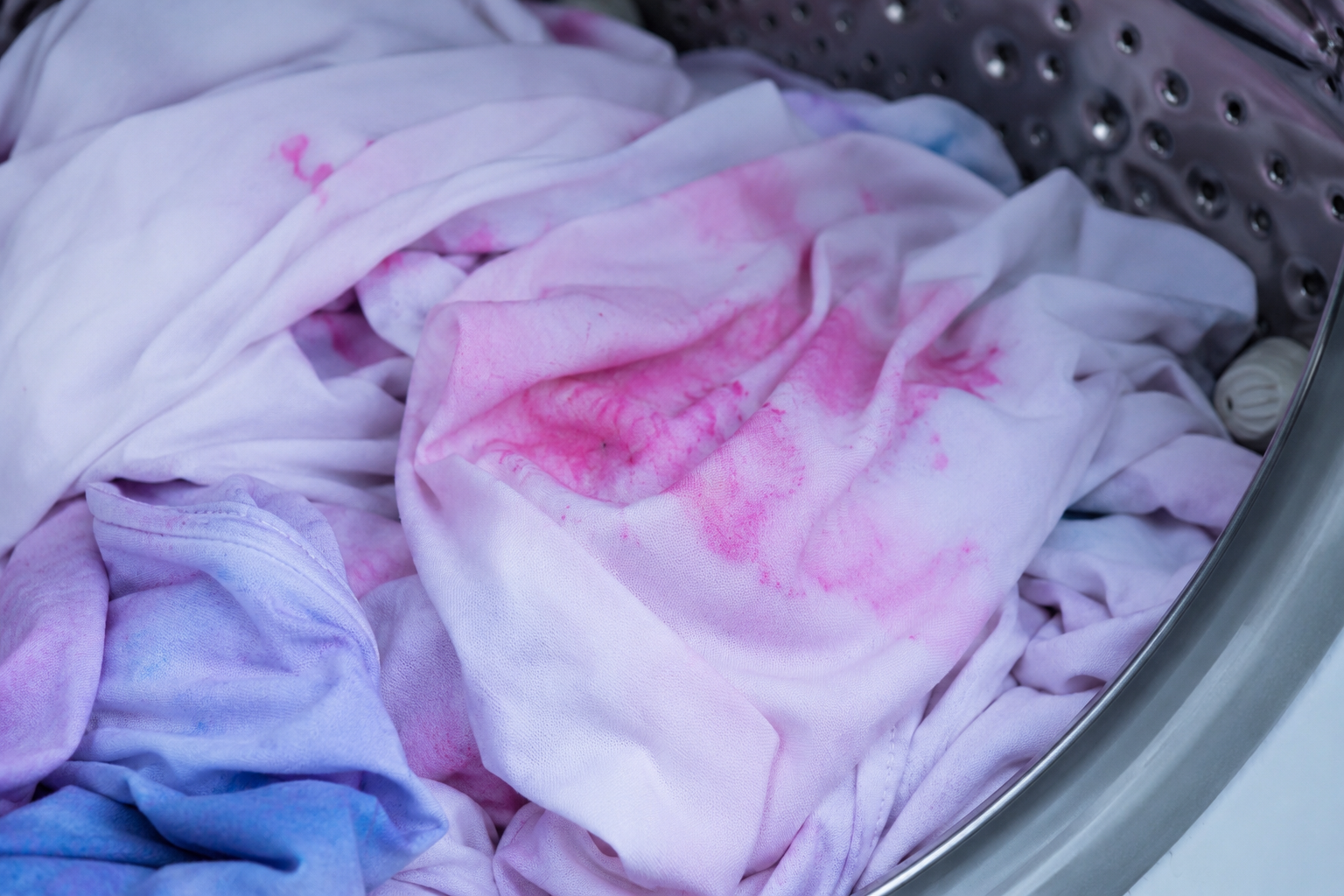
Color bleed gives you a short window and no warning. The moment the washer cycle ends, dye that is transferred onto lighter fabrics begins bonding more deeply with every passing minute – faster in warm conditions, slower if you act quickly. Most stained clothes are still fully recoverable at the thirty-minute mark.
By the time they dry, the odds shift significantly. This isn’t about technique or products. It’s about timing. Here’s exactly what to do and in what order.
Act Fast – What to Do in the First 30 Minutes
If you’re reading this right after the spill happened, start here. The next few steps give you the best chance of preventing permanent staining. Follow them in order, and whatever you do, keep the garment away from the dryer until you’re sure the stain is gone.
- Keep everything out of the dryer. Heat bonds transfer dye to fibers permanently. Once a stained item goes through the dryer, your options shrink fast. This is the single most important step.
- Re-wash in cold water immediately, no detergent. Run the affected clothes through a full cold cycle. Cold water flushes loose, unset dye out of the fabric before it can bond. Skip the detergent this round; you want a clean rinse, not a full wash.
- Inspect every item before moving on. After the cold rinse, check each piece individually. Still seeing color? Treat it before anything else. Even light residual staining can set permanently if you move to a warm cycle or the dryer too soon.
- Add an oxygen-based booster for whites and light colors. Products such as OxiClean break down dye residue without damaging the fabric. Add it to a second cold wash on items that still show staining after the initial rinse. Don’t mix it with chlorine bleach; use one or the other, not both.
- Repeat until the stain is gone. Some transfers lift in one cycle. Others take two or three. Keep going as long as you see improvement, and hold off on the dryer until you’re satisfied.
Rule of thumb: If you can still see it, don’t dry it.
Why Dye Bleeding Happens – and Which Items Are Most Likely to Bleed
Dye bleeding isn’t random. It almost always comes down to one thing: new garments carry excess dye that hasn’t fully bonded to the fabric. Hot water and agitation release that loose dye into the wash water, and whatever else is in the load absorbs it.
Items most likely to bleed:
- New dark clothes – deep reds, navies, blacks, dark greens – especially in the first two to three washes
- Fast-fashion pieces, which often use cheaper dye processes
- Natural fiber garments (cotton, linen), which are more porous, release dye more readily than synthetics
Items most likely to absorb transferred dye:
- Whites and off-whites
- Light grays and pastels
- Light-colored cotton items (T-shirts, children’s clothes, work blouses)
How wash temperature affects dye release:
| Setting | Risk Level | Best For |
|---|---|---|
| ❄️ Cold (60°F) | Low – safest option | Mixed loads, new dark items |
| 🌡️ Warm (90°–110°F) | Medium – increases dye release | Lightly soiled whites, cottons |
| 🔥 Hot (120°F+) | High – most likely to cause bleed | White-only loads, linens, towels |
Low – safest option
Mixed loads, new dark items
Medium – increases dye release
Lightly soiled whites, cottons
High – most likely to cause bleed
White-only loads, linens, towels
If you run hot mixed loads by default, and most busy households do, you already work against yourself every time a new dark item slips into the wash.
When Home Treatment Isn’t Enough
If you spot the problem right away, home treatment often works surprisingly well. Still, certain dye transfers are stubborn enough that they require professional stain removal techniques to fully correct.
Bring in a professional laundry service if:
- The stain is still visible after two cold washes and an oxygen booster treatment
- The item is silk, wool, or labeled dry clean only; these fabrics need controlled handling
- Heat already set the stain (the item went through the dryer before you noticed)
- The piece matters – a work blouse, a structured blazer, something sentimental
Professional laundry services use dye-release agents and temperature-controlled wash processes that home washing machines simply can’t replicate. For families in Manhasset and across the North Shore dealing with a garment that really can’t afford to be written off, a professional assessment is worth it before the damage becomes permanent.
How to Prevent Color Bleed in Future Loads
If your laundry routine is already packed into a busy week, don’t worry. You can avoid most color-transfer disasters with a handful of quick adjustments that take almost no extra time.
- Wash new darks separately for the first two to three washes. That’s when excess dye is highest. After that, most items are stable enough for mixed loads.
- Switch to cold water for mixed loads. It cleans everyday laundry just fine and dramatically reduces dye release.
- Turn dark garments inside out before washing. Less surface contact with other items. Bonus: it helps dark clothes hold their color longer.
- Toss a dye-catching sheet into every mixed load. Products such as Carbona Color Grabber absorb loose dye in the water before it reaches your clothes. One sheet per load, done.
The dye-catching sheet habit alone eliminates a large share of color bleed accidents in busy households. It’s a ten-second addition to every load.
Save Color-Bled Clothes with Expert Care at Tres Bon Dry Cleaners
The last thing you want is for a laundry accident to permanently ruin your favorite clothes. Bring in or send your garments to Tres Bon Dry Cleaners for professional color-bleed correction and organic dry cleaning, and enjoy the confidence of expert care, fresh-solvent cleaning, and FREE home Pickup and Delivery Service that make the entire process simple.
Contact Tres Bon Dry Cleaners Today
Phone: +1 (516) 963-0988